Antimony ore refers to mineral aggregates containing antimony that are suitable for industrial use. Based on ore genesis and the degree of oxidation, these ores are generally classified into three categories: sulfide antimony ores, oxide antimony ores, and mixed antimony ores. Antimony is a vital strategic metal widely used in high-value sectors such as flame retardants, photovoltaics, batteries, and the defense industry. Extracting antimony from ore involves a series of processing steps-including crushing, grinding, beneficiation, and dewatering-where the choice of technology and equipment at each stage directly impacts concentrate grade and recovery rates.
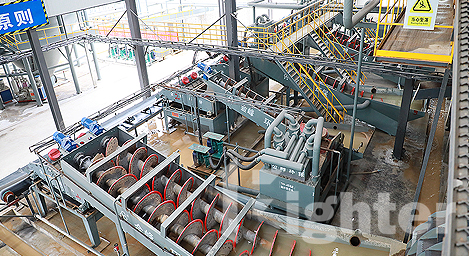
Crushing is the initial stage of antimony ore beneficiation, aimed at achieving preliminary mineral liberation and minimizing the feed size for the grinding circuit to enhance overall efficiency. A “three-stage crushing with one closed circuit” configuration is typically employed: primary crushing via jaw crusher, secondary crushing via cone crusher, and tertiary crushing via cone or impact crusher combined with vibrating screens. This closed-loop system produces fine material (≤12 mm) ready for the subsequent grinding stage.
The grinding stage often utilizes a combination of a ball mill and a spiral classifier, with coarse grinding controlled to achieve a product where 40%-50% of the material passes through a 200 mesh screen. Subsequently, jigs or spiral chutes are used to recover liberated coarse-grained antimony concentrate early in the process while discarding low-grade tailings; this pre-discarding step can remove 30%-50% of the tailings, significantly reducing the volume of material requiring downstream flotation. Gravity separation tailings undergo classification via hydrocyclones and are then finely ground-targeting 65%-75% passing 200 mesh to achieve full mineral liberation. Finally, a standard flotation process is applied, with precise control over reagent concentrations to consistently improve concentrate grade. In recent years, some processing plants have also incorporated high-pressure grinding mill into the intermediate and fine crushing stages to further reduce energy consumption, lower the difficulty of subsequent grinding, and boost overall economic efficiency.
During the classification and separation stages, a hydrocyclone cluster is employed to strictly control grinding fineness; classification efficiency can reach 60%-80% (optimized based on feed concentration and ore characteristics), thereby enhancing beneficiation efficiency. A combined gravity separation and flotation process may be adopted to produce high-purity antimony concentrate at a lower cost, boosting project profitability and resource recovery rates.
.png)


